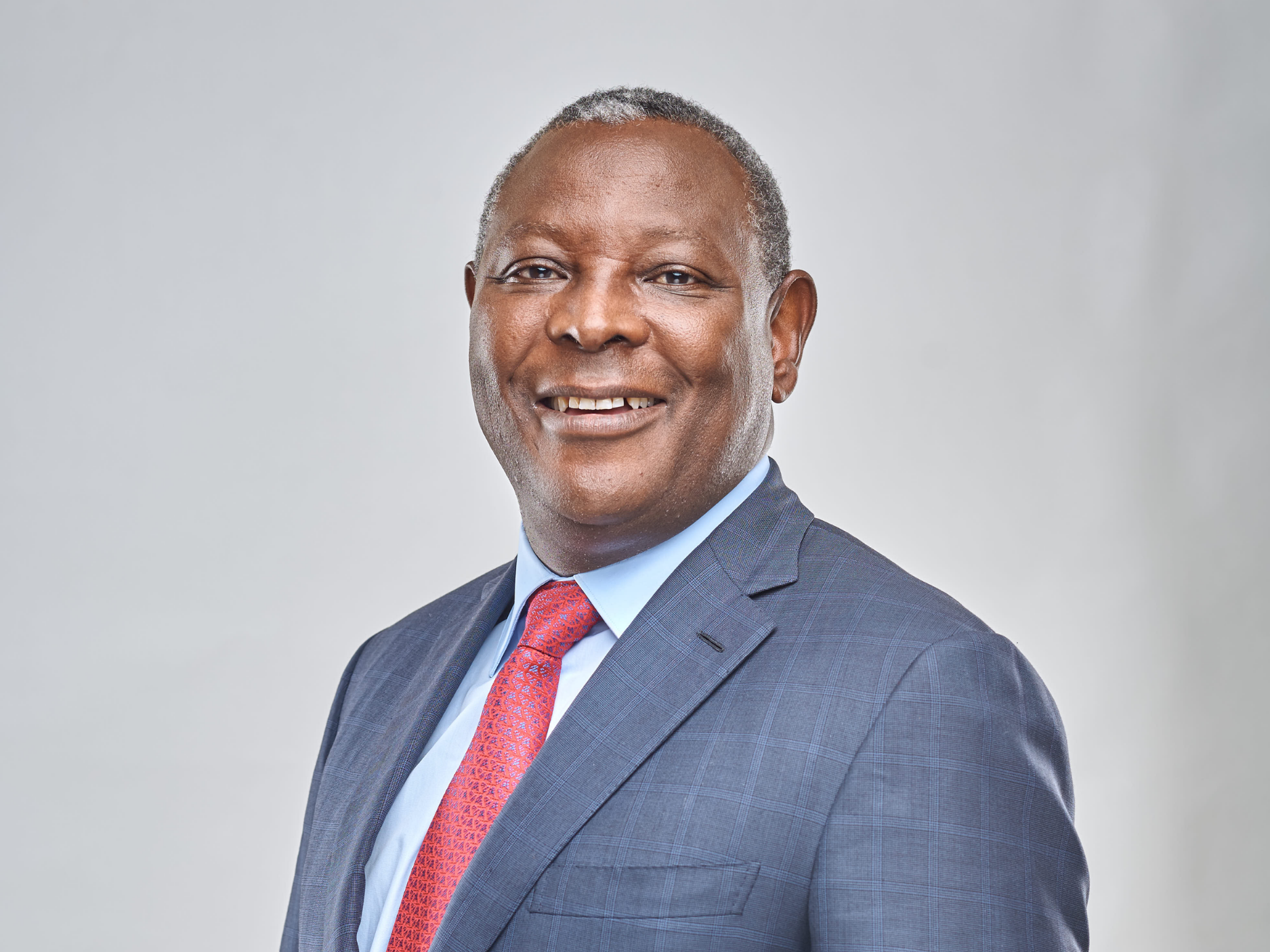
Name: James Mwangi
Role: Group Managing Director and Chief Executive Officer
Company: Equity Group Holdings
Industry: Banking and diversified financial services
Company size: KSh2.16 trillion in assets and 23.3 million customers as at June 2026
Years in company: 35 years, since joining Equity in 1991
James Mwangi: The Banker Who Turned Financial Exclusion Into Scale
When James Mwangi joined Equity Building Society in 1991, the institution was not an obvious platform for regional banking leadership.
It was a small mortgage lender with limited capital, weak systems and declining confidence among its customers. By 1993, it was ranked last among Kenya’s 66 building societies. It was technically insolvent and losing approximately KSh5 million annually.
Three decades later, Equity Group Holdings serves more than 23 million customers and operates across several East and Central African markets.
The transformation is often described as a turnaround. That is accurate, but incomplete. Mwangi did more than repair a failing institution. He changed its customer, cost and distribution model.
His central insight was that low income customers were not unbankable. They were poorly served by banking systems designed around branches, paperwork, large balances and formal employment.
Rebuilding From the Customer Outward
Mwangi joined Equity as finance and operations director. He became chief executive in 2004, although he had already played a central role in restructuring the organisation.
The early turnaround required restoring confidence. Equity strengthened financial controls, improved customer service and simplified its products. It focused on small traders, farmers, salaried workers and households that established banks often considered too expensive to serve.
That choice shaped the institution’s culture.
Instead of expecting customers to adapt to conventional banking, Equity adapted banking to the realities of its customers. It reduced minimum balances, made account opening easier and placed staff closer to local communities.
The commercial logic depended on volume. Small deposits and modest transactions could become profitable when delivered to millions of customers through an efficient operating system.
Technology and alternative distribution channels made that scale possible. Equity expanded through mobile banking, agency banking, merchant networks and digital payments. Branches remained important, but they were no longer the only place where banking occurred.
By June 2026, approximately 98.3 per cent of the group’s transactions were taking place outside traditional branches, with about 89.7 per cent processed through digital channels. Equity reported 92,572 agents, 1.4 million merchants, 886 automated teller machines and 410 branches.
This is more than digital adoption. It is a restructuring of banking economics.
Agents reduce the cost of physical expansion. Mobile channels allow customers to transact without losing time travelling to branches. Merchants extend the bank into everyday commerce. Data generated by those transactions can improve credit decisions, although it also creates responsibilities involving privacy, cyber security and fair lending.
From Kenyan Turnaround to Regional Institution
Equity expanded beyond Kenya into Uganda, Tanzania, Rwanda, South Sudan and the Democratic Republic of Congo.
Regional expansion created access to larger markets, but it also increased complexity. Each country has different regulations, currencies, political risks and customer behaviours. A regional bank must establish common standards without assuming that one national model can simply be copied elsewhere.
The Democratic Republic of Congo has become particularly important to Equity’s growth. The acquisition and integration of local banking operations gave the group exposure to one of Africa’s largest populations and a market with substantial demand for formal financial services.
By the first half of 2026, subsidiaries outside Kenya contributed 42 per cent of the group’s banking profitability, 47 per cent of revenue, 51 per cent of deposits, 54 per cent of loans and 52 per cent of total assets.
These figures show that Equity is no longer simply a Kenyan bank with foreign branches. It is becoming a regional financial group.
The strategy produced strong results in the six months ended June 2026. Profit after tax increased 32 per cent to KSh45.5 billion. Total income rose 25 per cent to KSh124.9 billion, while the balance sheet expanded 20 per cent to KSh2.16 trillion. Customer deposits reached KSh1.59 trillion and loans reached KSh981 billion. The group’s official results announcement also reported an improvement in the nonperforming loan ratio from 13.7 per cent to 9.5 per cent.
The results demonstrate scale and momentum. They also reveal the responsibilities that come with rapid growth.
Credit expansion must be matched by risk controls. Digital growth increases exposure to fraud and cyber attacks. Regional diversification can reduce dependence on Kenya, but it introduces currency and political risk. Artificial intelligence may improve productivity and credit analysis, but poorly governed systems can amplify bias or make decisions customers cannot challenge.
Mwangi’s next test is therefore different from the one he faced in the 1990s. He is no longer trying to save a small institution. He is responsible for ensuring that a systemically important regional group grows without losing the trust that made its expansion possible.
Social Impact as Business Infrastructure
Equity’s social programmes are organised primarily through Equity Group Foundation.
The foundation has supported 60,009 secondary school scholarship beneficiaries and more than 29,000 university scholars. Its programmes also cover entrepreneurship, agriculture, health, energy, environmental protection and leadership development. Equity Group Foundation presents education as part of a broader strategy for economic mobility.
The relationship between the bank and foundation reflects Mwangi’s belief that financial services work best when customers have the knowledge and productive capacity to use them.
Entrepreneurship training can improve the quality of potential borrowers. Scholarships can expand the future professional class. Agricultural support can strengthen rural businesses. These programmes have social value, but they can also deepen the economic ecosystems in which Equity operates.
That alignment should still be judged carefully. Social impact claims require transparent measurement, not only large beneficiary numbers. The central question is whether programmes produce durable improvements in income, employment, business survival and opportunity.
Mwangi’s long term ambition is substantial. Equity aims to operate in 15 countries and serve 100 million customers by 2030.
Reaching that scale will require acquisitions, technology, capital and capable local leadership. It will also require the group to protect the principles that powered its original turnaround: accessibility, dignity, simplicity and trust.
Mwangi’s career shows that inclusion can be commercially powerful when it is built into the operating model rather than treated as a public relations programme. Equity succeeded because it saw millions of excluded people not as a social burden, but as customers whose economic lives deserved to be understood.
Key Lessons
- Redefine the customer before redesigning the company. Equity changed because it built its strategy around people conventional banks overlooked.
- Inclusion requires an operating model. Affordable services become sustainable only when technology, distribution and cost structures support them.
- Trust is a financial asset. Depositors remained with a struggling institution because leadership restored confidence through service and discipline.
- Regional growth requires local intelligence. Scale cannot replace an understanding of regulation, culture and risk in each market.
- Social impact is strongest when connected to commercial capability. Education, entrepreneurship and financial access can reinforce one another when outcomes are measured honestly.