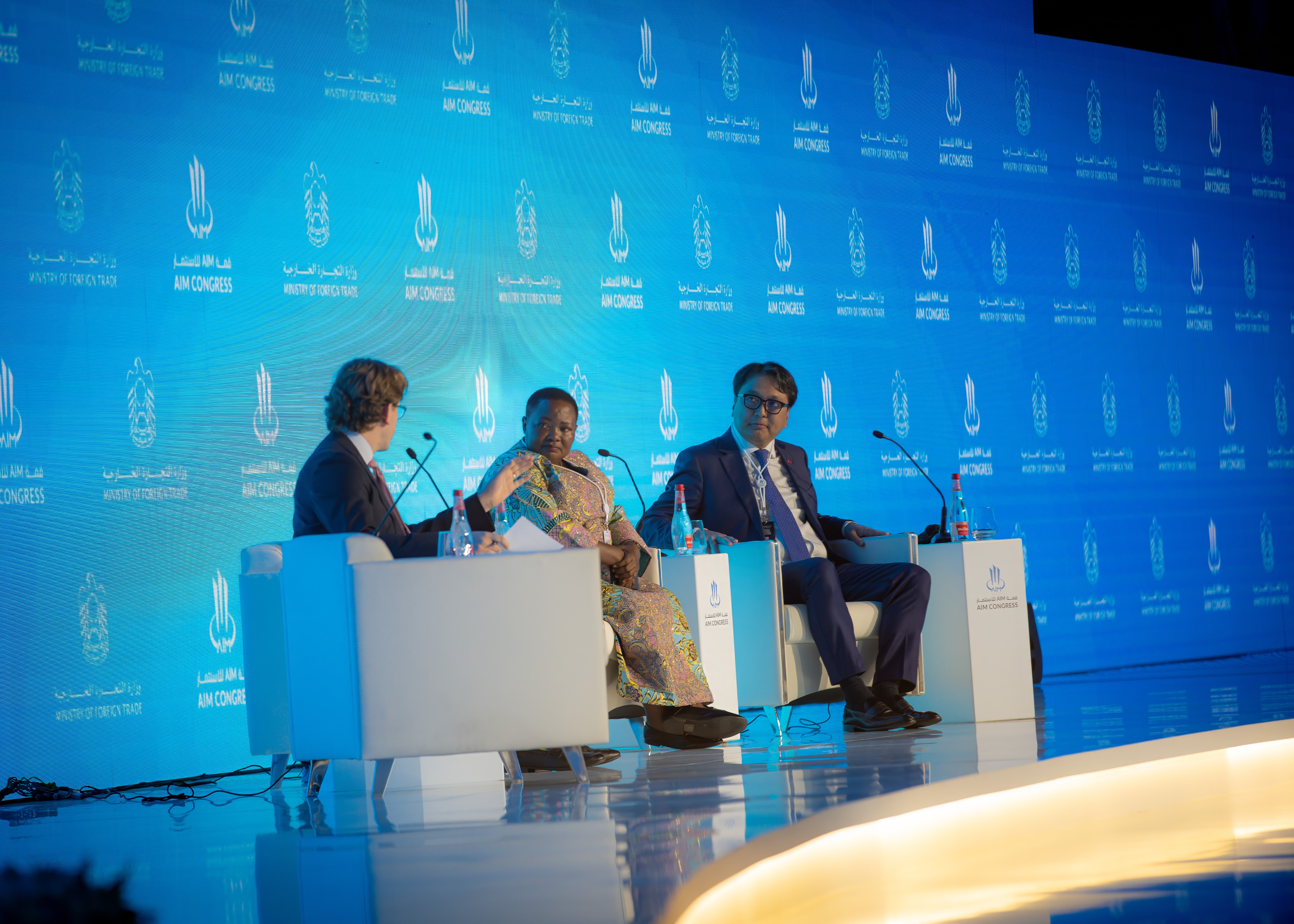
Prime Minister Robinah Nabbanja came to AIM Congress with a ten-point strategy and a reframing that matters well beyond Uganda’s borders.
DUBAI — Speaking in a session on regional blocs and landlocked economies at the 15th AIM Congress, Uganda’s Prime Minister Robinah Nabbanja declined the terms of the debate she had been invited into.
“Land-linked, not landlocked,” she told delegates.
It is a small phrase carrying a large argument. Landlocked is a description of cost, distance from a port, freight priced accordingly, a permanent discount applied to everything a country produces. Land-linked describes position: a country sitting at the junction of markets rather than at a remove from the sea. One is a constraint to be compensated for. The other is an asset to be sold.
The Prime Minister spent her session making the case that Uganda has earned the second description.
A ten-point strategy, and what it prioritises
Uganda’s stated objective is to grow into upper-middle-income status, and the vehicle is a ten-point growth strategy. Four pillars carried the pitch in Dubai.
Agro-industrialisation came first, and with it the sharpest commercial argument of her address. Uganda produces agricultural volume at scale and is, in her description, the continent’s largest coffee producer. But the ambition she put to investors was not to ship more of the crop out. It was to attract investment into coffee with the UAE and Europe named as target markets, so more of the value is captured before the product leaves the country.
Tourism followed, built on Uganda’s climate, environment and natural assets, with a plain objective: bring more people to Uganda.
Mineral development came third. Uganda, she said, is gifted by nature — gold, copper, and oil and gas.
Science and technology completed the set she placed in front of investors.
Beneath all four she put two enablers she returned to repeatedly. The first is that Uganda is at peace and secure. The second is connectivity: the country is now tarmacked east to west and north to south, a road network built for functional logistics rather than for show and the practical reason a landlocked geography no longer operates as a commercial ceiling. She also pointed to a policy framework designed to protect Ugandan businesses while guaranteeing investors a fair and sustainable operating landscape.

Turning the question around
Asked whether there is in fact any advantage to being landlocked with a densely settled population, the Prime Minister inverted the premise rather than defending against it.
That population is connected, she said by tarmac, by strategic road and transport development, and increasingly to industrial power. And it is overwhelmingly young: 78 percent of Ugandans are aged 31 or under. She presented the figure as an obligation before a selling point. The government’s answer, she said, is to build more schools and equip that generation with the resources to succeed in life.
Asked how a government plans when the future is unpredictable, she did not hedge. Uganda’s future, she said, is very bright. The country is using its energy endowment well, the Nile, its largest river, and has been attracting serious investment on the strength of it, with value addition already underway. As for being landlocked: Uganda, she said, is taking advantage of it.
What it signals for Africa
The reframing travels further than Kampala. Sixteen African countries are landlocked, and for most of them the label has functioned as a permanent commercial handicap, a reason investors discount, and a reason governments plead.
Three things make the Ugandan argument worth other capitals’ attention.
First, the African Continental Free Trade Area changes the arithmetic. A landlocked country cut off from the world is a stranded economy. A landlocked country inside a functioning continental single market is an interior market, surrounded by customers rather than separated from ports. That is the shift the AfCFTA is designed to deliver, and it is the foundation the Prime Minister’s phrase rests on. Whether “land-linked” is a description or an aspiration depends on how quickly the agreement moves from ratification to operation.
Second, the pitch was structural, not sentimental. Roads, security, policy protections, demographics, these are the things investors actually price. It is the same register heard across the Congress from Ethiopia’s president and from the Africa Pavilion: evidence offered rather than potential asserted. African delegations in Dubai were noticeably less interested in being believed in than in being assessed.
Third, the coffee argument is the continental argument in miniature. Attracting investment into coffee rather than exporting more coffee is the same case made on the Congress’s critical minerals panel, where the managing director of Lucara Botswana put it bluntly: the raw material is African, the processing is not, and the processed product sells for several times the price of the input. Uganda’s version arrives without the mineral, but the logic is identical, the value must stay closer to where the crop grows.
Coming a day into a Congress preoccupied with where global capital will settle, the timing was well judged. Capital in the room said openly that it moves toward certainty, connectivity and the ability to execute. A landlocked country that can demonstrate roads, peace, policy and a young workforce is answering that list directly.
The phrase will be quoted for its neatness. The substance is in whether the roads, the free trade area and the value addition hold up under investor scrutiny, which is the test Uganda invited.
AIM Congress 2026 runs 7–9 September at the Dubai World Trade Centre. Pan-African Voice is an official media partner of AIM Congress, reporting on all things Africa throughout.