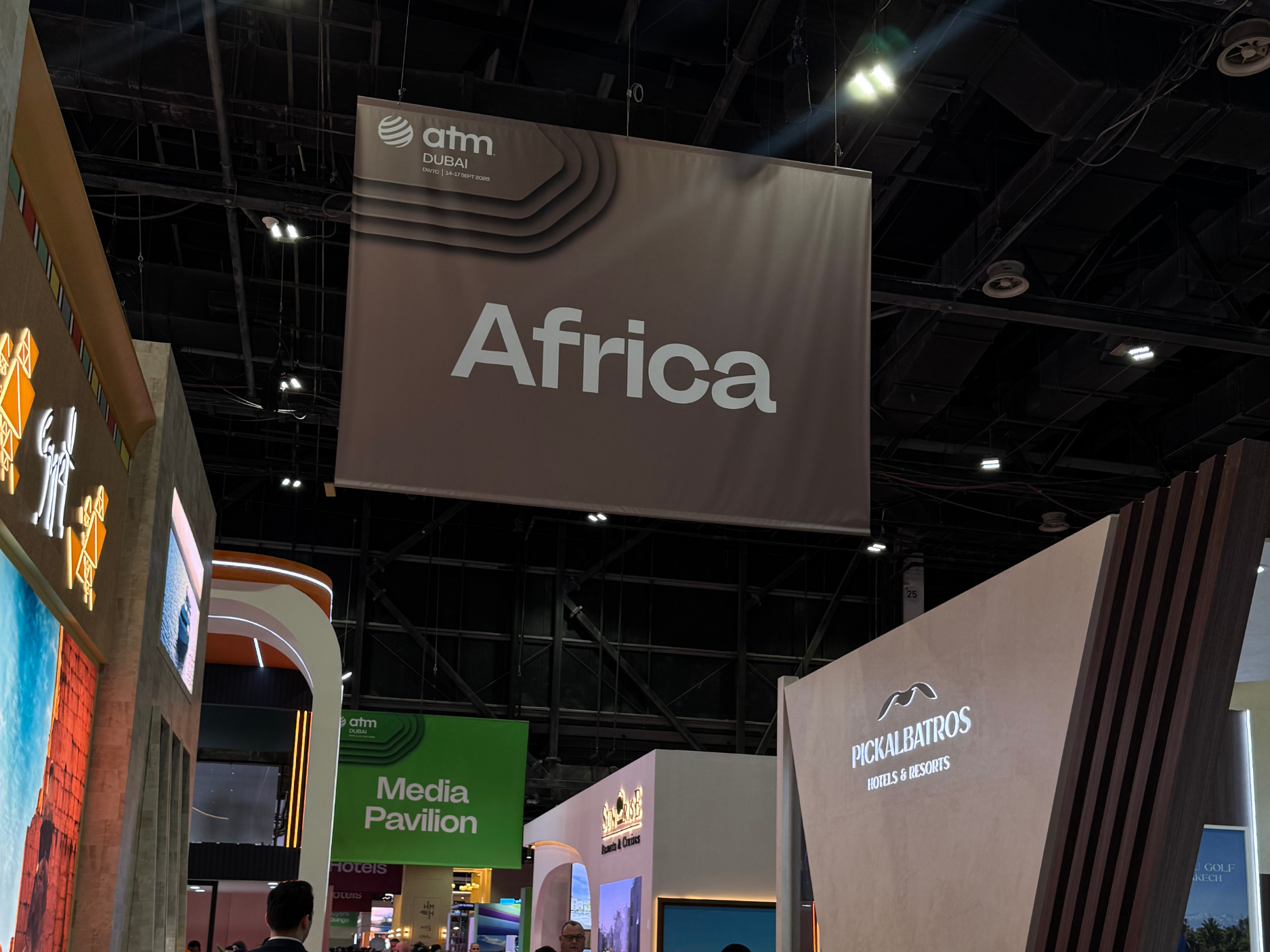
The 33rd Arabian Travel Market returned to Dubai after two postponements, with recovery, technology and partnerships at the top of the agenda. Pan African Voice reviews the defining moments of the week, the African destinations that made headlines, and why travel between Africa and the UAE carries growing strategic weight.
A Comeback Edition
Dubai World Trade Centre hosted Arabian Travel Market (ATM) from 14 to 17 September 2026. Organiser RX Global moved the 33rd edition out of its usual May slot as regional conflict disrupted travel across the Gulf, first to August and then, after consulting exhibitors, to September. The show still brought together 1,405 participating organisations under the theme “Travel 2040: Driving New Frontiers Through Innovation and Technology”.
The timing gave the show a sharper purpose. Figures released by Dubai’s Department of Economy and Tourism on the opening day showed the emirate welcomed 6.97 million international overnight visitors between January and August, including around 869,000 in August, the highest monthly total since February. Hotel occupancy climbed to 66 per cent in August, up from 36 per cent in March.
His Highness Sheikh Mohammed bin Rashid Al Maktoum, Vice President and Prime Minister of the UAE and Ruler of Dubai, and His Highness Sheikh Hamdan bin Mohammed bin Rashid Al Maktoum, Crown Prince of Dubai, both toured the exhibition on its opening day. Sheikh Hamdan said Dubai “will remain the destination and meeting point where the future of the global travel and tourism sector is shaped.”
The Week’s Defining Moments
A ministerial debate on the opening day set the tone. His Excellency Abdulla bin Touq Al Marri, UAE Minister of Economy and Tourism, reframed the discussion around the strength of the country’s tourism base. “Everyone talks about tourism resiliency; I talk about tourism foundations,” he said. “We saw the storm, we were in the middle of the storm, and we managed to manoeuvre ourselves perfectly.” Her Excellency Shaikha Al Nuwais, Secretary General of UN Tourism, argued that the countries best equipped for a crisis are those that prepare well in advance. “They build relationships early, they share information and they build trust,” she said.
Technology ran through the programme. ATM Travel Tech made its debut with more than 180 exhibitors from 30 countries across two halls, alongside an 850 square metre Tech and Innovation Hub devoted to artificial intelligence, immersive technology, robotics, fintech and green solutions.
The UAE’s national carriers generated much of the commercial news. Etihad Airways unveiled new cabins for its Airbus A330neo and A321LR aircraft and signed an agreement with Etihad Rail to explore integrated air and rail travel. Emirates signed seven destination partnerships on the opening day and 11 further agreements on the second. Its recovery underpins that activity. According to Adnan Kazim, Emirates Deputy President and Chief Commercial Officer, the airline carried 8.7 million passengers in July and August, up from 4.7 million in March and April.
Africa’s Presence in Dubai
For Africa, the most significant announcements of the week came from the Indian Ocean. Three of the seven destination agreements Emirates signed on the opening day were with African partners in Seychelles, Mauritius and Madagascar.
Emirates renewed its longstanding partnership with the Seychelles Tourism Board and the Ministry of Tourism and Culture, covering joint marketing campaigns and familiarisation trips for media and the travel trade. According to the Tourism Board, around 60 per cent of international visitors reach Seychelles through Dubai, Doha or Abu Dhabi. Its Chief Executive Officer, Vesna Rakic, described the Gulf Cooperation Council (GCC) as “central to Seychelles’ tourism future”, both as a source of high spending visitors and as “an aviation bridge connecting our islands with the world”. The islands recorded 232,342 visitor arrivals in the first seven months of 2026.
Mauritius brought a delegation of around 20 partners, assembled by the Mauritius Tourism Promotion Authority, and renewed a partnership with Emirates that stretches back more than 20 years. Arrivals from the Middle East rose 10.5 per cent year on year between January and July 2026. “A 10.5 per cent increase in seven months tells us the GCC has already made up its mind about Mauritius,” said Benoit Harter, Director of the Authority. Emirates operates three daily flights to the island, offering 19,096 seats a week in both directions.
Madagascar’s Ministry of Tourism and Handicrafts signed a new agreement with Emirates covering advertising, incentives, tailored packages and familiarisation trips, in support of the country’s target of welcoming one million tourists by 2028.
African interest extended to the aisles. Gulf News spoke to Kidist, an Ethiopian travel agency director attending ATM for the first time, who said she came to grow her network because the UAE is “a very big hub for the Middle East”. The organiser’s data points the same way. Figures RX Global released in January showed participation from Africa growing faster than from any other region, at a compound annual rate of 31.99 per cent since 2024, more than double the rate for Asia.
Why the Corridor Matters
Travel between Africa and the UAE runs in both directions. Africa supplied 5 per cent of Dubai’s international overnight visitors between January and August, according to the Department of Economy and Tourism, while the Indian Ocean agreements signed at ATM show how closely island destinations depend on Gulf travellers and Gulf hubs.
Airlines are adding capacity to match. Etihad has extended its seasonal Zanzibar service, launched in June, to March 2027, and its new route to Asmara opens on 7 November. Asmara is the first of six African destinations Etihad announced in April, with Accra, Kinshasa, Lagos, Harare and Lubumbashi planned to follow. “Africa is a natural and compelling next step in Etihad’s network expansion,” said Chief Executive Officer Antonoaldo Neves at the time. The UAE and Egypt also signed a five year agreement in Cairo in July to expand air traffic rights in phases, giving carriers room to add flights as demand grows.
Trade adds a further layer. In May and June, Dubai Chamber of Commerce led missions to Accra, Addis Ababa and Johannesburg, where 45 Dubai companies held 1,460 bilateral business meetings, including a record 510 in the Ethiopian capital. Commercial ties on that scale feed the business travel and repeat visits that give the corridor depth beyond leisure.
North Africa’s leisure outlook is also strong. Research released by the organisers in January projected a 21 per cent rise in outbound leisure nights from the Middle East to Egypt by 2030.
The Road Ahead
The 2026 edition offers African destinations a clear lesson. Seychelles, Mauritius and Madagascar each combined a national tourism body, an airline partner and a defined market goal, and each left the opening day with a signed agreement. The next opportunity lies on the mainland, where new Etihad routes are set to link Abu Dhabi with West, Central and Southern Africa, and where Dubai’s business community is already building relationships that turn into regular travel.
With one in every twenty of Dubai’s international visitors already coming from Africa, the routes announced, partnerships renewed and trade missions completed in 2026 give both sides a practical foundation to grow that share. They also give more African destinations a strong reason to claim their place on the show floor when ATM returns.
Discover more from Pan-African Voice
Subscribe to get the latest posts sent to your email.