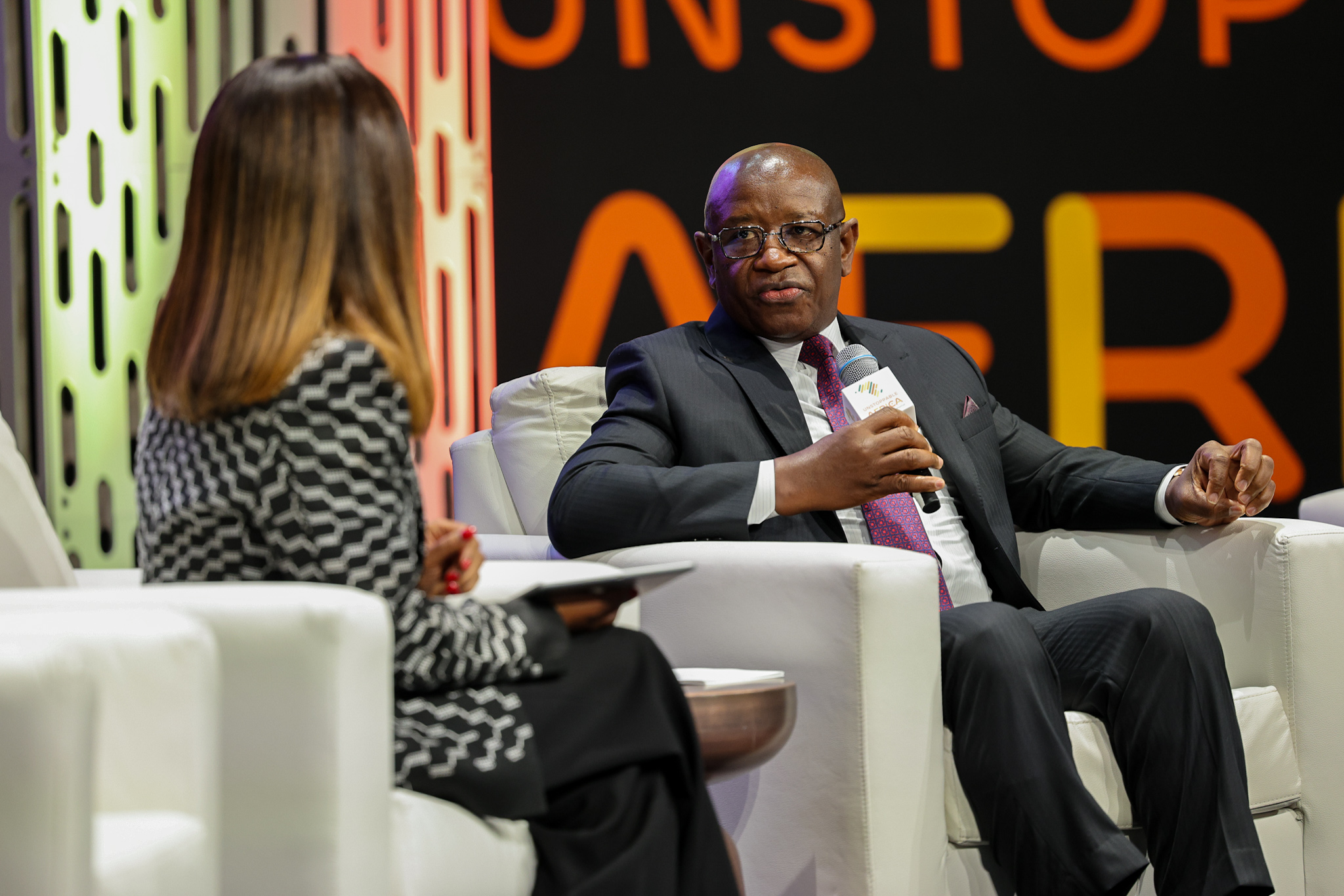
Sierra Leone’s president opened the fifth edition of the Global Africa Business Initiative’s flagship gathering in New York with a direct reading of the global race for African resources.
New York, reported live by Pan African Voice, official media partner of Unstoppable Africa 2026.
The setting
Unstoppable Africa 2026 opened at the Marriott Marquis in New York this weekend, five years after the Global Africa Business Initiative began convening African enterprise and global capital alongside the United Nations General Assembly. Close to 3,000 delegates are attending the two day programme, with government delegations from more than twenty African countries. Pan-African Voice is one of 24 official media partners accredited to the event. Sanda Ojiambo, Assistant Secretary General and Executive Director of the United Nations Global Compact, opened by valuing the prize at a three trillion dollar market opportunity and urging delegates to settle what gets built, financed and scaled. When Africa wins, in her framing, the world wins. Mahmoud Ali Youssouf, Chairperson of the African Union Commission, supplied the conditions: a market of 1.5 billion people needs African value chains, and those need cheap and abundant energy, good infrastructure, access to capital markets, skills, technology, standards and certification, all underwritten by peace and stability.

Speaking for a continent, and for its young
His Excellency Julius Maada Bio, President of the Republic of Sierra Leone, began by widening his own mandate.
“When I speak as the President of Sierra Leone, I also speak for all of Africa…And when I talk, I talk on behalf of the youth of Africa.”

That demography, he argued, is the continent’s genuinely scarce asset in a world short of workers, and it is undermined by a perception problem Africa did not author. “The way we are perceived has been manipulated,” he said, referring to the United Nations vote adopting the Equal Earth projection, a campaign he credited to Togo. His prescription was attitude before technical:
“For Africa, I want us to be bold, audacious in how we think about ourselves.”
Infrastructure that serves more than the mine
Pressed on where the opportunity sits, Bio returned to infrastructure. Colonial era rail and road, he said, moved ore from the mine to the ship and served nobody in between. “We should not allow the exploitation of natural resources with infrastructure that takes just from the mine into the port,” he said, calling instead for multi user corridors that carry agricultural produce and people.
“When we export raw, we are exporting the value and also the jobs that go with it,”
he continued, linking that loss to the young Sierra Leoneans crossing the Mediterranean in search of opportunities that left with the ore. His line on resource sovereignty was the sharpest of the session:
“If our resources are critical for the world, then they should be critical for our transformation.”
With overseas development assistance shrinking, he said, African governments want patient private capital that treats digital and physical infrastructure as a business case, arriving as partners rather than as buyers of access. It is the same argument Pan-African Voice has tracked across the Gulf, where African missions are converting political goodwill into investment.
Controlling the scramble
Asked how governments avoid repeating old patterns of dependency, Bio named the moment directly.
““The scramble for Africa is back on the table…but we have to control the scramble by making sure that we make deliberate choices that matter.”
He urged African leaders to negotiate collectively: “We should sit together and decide on whose terms these things have to be programmed.” No national strategy, he argued, should permit extracting raw and exporting raw, with value addition done nationally or through regional corridors where scale demands it.
On the United Nations Security Council, where Sierra Leone coordinates the African Union’s campaign for permanent representation, he was pointedly patient. Reform has gone nowhere for more than twenty years, yet “we should not be tired of knocking at the doors.” More than 60 per cent of the Council’s agenda concerns Africa, he noted. “If we talk about democracy at the national level, we should not make hypocrisy about it at the international level.” A continent of 1.4 billion people accepting exclusion as normal is itself the abnormality.
The third term question
The session closed on domestic politics. Asked about persistent speculation that he might seek a third term, Bio did not hedge. “My word is my bond,” he said, invoking his military background.
“I cherish democracy. I am going to stand by my word. We have a term limit, and that is what is going to prevail.”
For investors weighing Sierra Leonean and wider West African economy, that was the most bankable sentence of the morning.
Watch Unstoppable Africa live here: https://www.youtube.com/watch?v=QceEdFmpWxI
Discover more from Pan-African Voice
Subscribe to get the latest posts sent to your email.