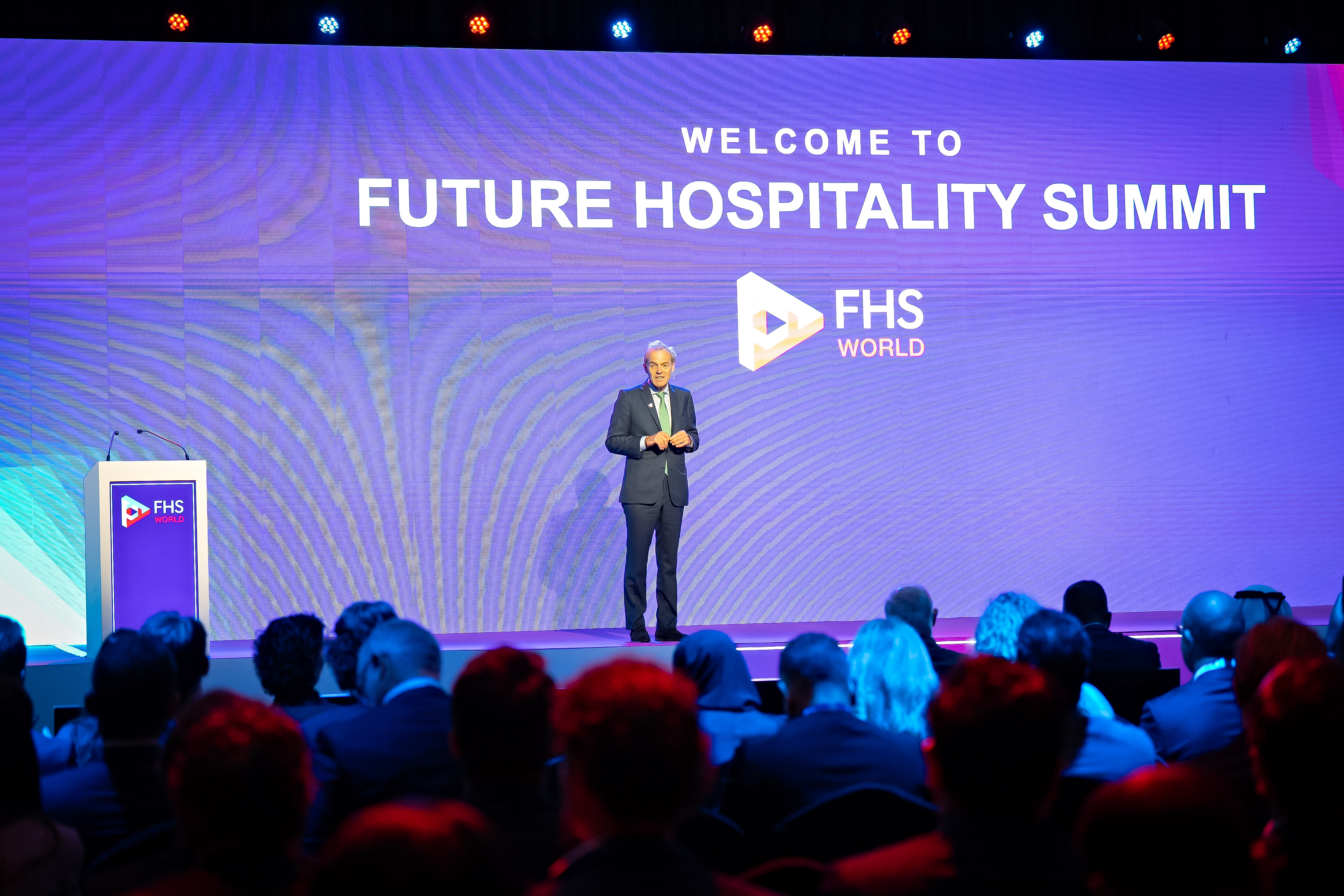
As the Future Hospitality Summit opened in Dubai, its organisers argued that leadership, trust and technology will decide where the next wave of hotel capital flows.
A room built for deals
When Jonathan Worsley took the stage at Madinat Jumeirah on 29 September to open FHS World 2026, his first instruction to one of the hospitality industry’s densest gatherings of capital was disarmingly simple. He asked every delegate to stand and greet someone they had never met. The gesture had a serious purpose. The Future Hospitality Summit, which Worsley’s company The Bench has built over 21 years, exists to put owners, operators, lenders and governments in the same room, and its founder made clear that the conversations started on the floor matter as much as anything said from the podium.
The summit runs until 1 October under the patronage of His Highness Sheikh Ahmed bin Saeed Al Maktoum, with the theme “Reinvest in Our Future”. For Pan- African Voice, an official media partner of this year’s edition, the theme arrives at a telling moment. Gulf capital is looking beyond its home markets, and Africa sits high on that list.
Hospitality as the region’s calling card
Worsley, who became Chairman of The Bench in January, opened with a traveller’s story rather than a statistic. He described flying in from London and arriving at his hotel in the small hours, met with warmth at every step of the journey. In an industry racing to automate, he argued, those human moments carry more weight, not less.
“Even more in our day and age, when we’re going fast towards AI, everybody’s running at pace,” he said.
Such encounters, in his telling, are “the essence of the region” and of the UAE’s approach to its visitors.
He thanked the UAE’s tourism authorities for their support and told delegates that His Excellency the minister, called away to an important meeting, would join the programme on the second day.

The numbers behind the confidence
Worsley then handed over to Ali Shahid, who took over as Chief Executive of The Bench in January after nearly nine years with the company. Shahid spoke personally. He lived in Dubai for fifteen years, began his career in the city and saw his son born there, so returning for a September edition after a turbulent start to the year carried particular weight.
“What has changed?” he asked the room. His answer was that almost everything had, yet the things that matter had only grown stronger: the resilience of the region, the scale of its capital and the depth of its hospitality.
“The quality of people is stronger than ever,” he said.
He anchored that optimism in data. Citing the World Travel and Tourism Council, he noted that travel and tourism is forecast to contribute around $12 trillion to the global economy this year and to support 376 million jobs, roughly one in every nine worldwide. He set that against the pandemic, when the industry was effectively shut down. On the Middle East, he summarised the impact of this year’s regional disruption as “sharp but temporary”. The council’s August outlook for the region puts figures to both halves of that phrase: a 14.5 per cent contraction in the region’s travel and tourism GDP in 2026, from $386 billion to $330 billion, alongside a projection that the Middle East will be the world’s fastest growing tourism region over the coming decade, expanding at 6.3 per cent a year to reach $605 billion by 2036.
Resilience that is already visible
Shahid pointed to Ras Al Khaimah as evidence that markets which adapt quickly can hold their ground. By leaning into domestic demand, the emirate welcomed 670,000 visitors in the first half of 2026, its strongest first half on record, with domestic arrivals up 47 per cent year on year, according to figures reported in July. Its pipeline adds conviction: Wynn Al Marjan Island, the emirate’s flagship integrated resort, is scheduled to open in 2027.
An industry that will not look like today’s
His sharper message concerned what comes next. The industry being built today, Shahid warned, will not resemble the one guests will expect tomorrow. He cited research showing that two thirds of travellers in the UAE and Saudi Arabia would trust AI to book their accommodation, a finding from a Marriott International study published late last year, and to forecasts that humanoid robots will become commonplace within a generation. He acknowledged that such change can feel unsettling, but framed it as an opening for operators willing to transform rather than a threat to be managed.
For investors, his prescription was notably unglamorous. Recovery, he argued, is the product of patient investment over a decade and of “the right leadership, the right brand, the right strategy”. That combination, he said, is how the industry earns the trust of capital. He also drew attention to fresh pipeline data for the Middle East and North Africa, describing a substantial volume of hotels under development across both regions.
Why this matters for African markets
For Pan-African Voice readers, the summit’s value lies as much in the audience as on the stage. The organisers list more than 38 investment entities in attendance, among them Katara Hospitality, Al Futtaim Real Estate, First Abu Dhabi Bank and Mashreq, and Shahid said The Bench’s investor relations team had arranged meetings between sponsors and investors based on data about their mandates. Confirmed speakers include Sir Tim Clark, President of Emirates Airline; William Heinecke, Founder and Chairman of Minor International; René Nijhof, Chairman of Kempinski Hotels; and Philippe Zuber, Chief Executive of Kerzner International.
The African dimension is already evident in the conversations Pan-African Voice has held with summit speakers. Hala Matar Choufany, President of HVS for the Middle East, Africa and South Asia, told the publication ahead of the event that Gulf capital is moving into African markets and that Egypt alone accounts for more than a third of the continent’s hotel pipeline, a reminder of why North African data drew attention from the main stage. Radisson Hotel Group’s Ayman Ezzeddine described growth led by demand through conversions, serviced apartments and secondary cities.
That last theme runs directly into the programme. Sessions span wellness tourism, branded residences, sustainability, restaurant investment, technology and women’s leadership, while FHS Living on 1 October is devoted to the hotelisation of real estate assets, a model with clear relevance to fast urbanising African cities where serviced apartments and conversions are already reshaping supply.
The measure of success
Shahid closed where Worsley began, with the room itself. Everything delegates take away from Madinat Jumeirah, he said, has the power to shape the industry: “A deal, a partnership, an idea, an exchange.” Over three days, the test for FHS World 2026 will be whether those exchanges become committed capital, including in the African markets that Gulf investors are studying with growing seriousness. Pan-African Voice will be on the ground throughout, interviewing the decision makers behind those commitments.
Discover more from Pan-African Voice
Subscribe to get the latest posts sent to your email.