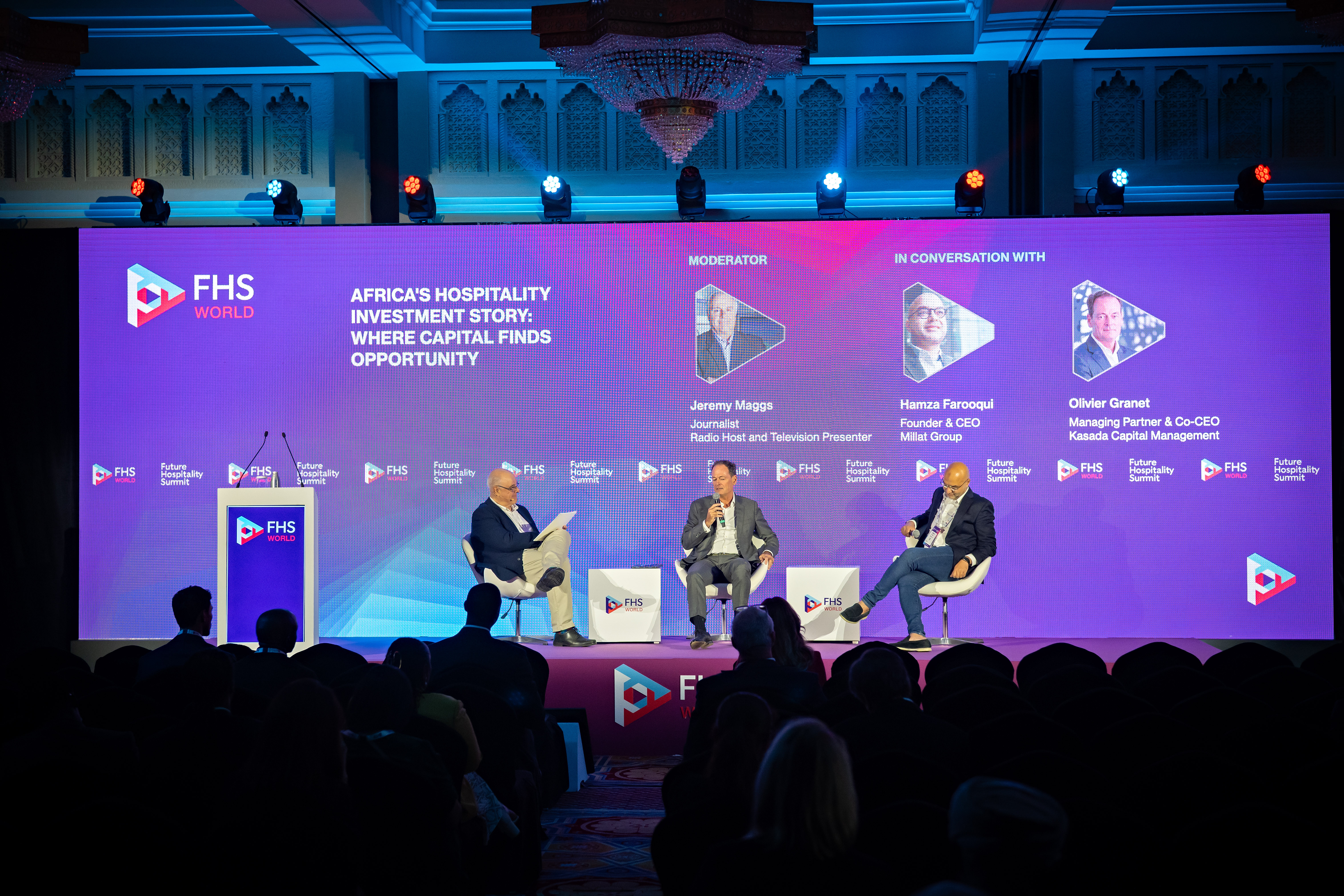
At FHS World 2026 in Dubai, Millat Group’s Hamza Farooqui and Kasada’s Olivier Granet argued that Africa rewards capital willing to fix, operate and price risk one country at a time.
Jeremy Maggs, the Johannesburg broadcaster who moderated the session, named the problem at the outset. Africa, he told the Future Stage audience at Madinat Jumeirah, has fast growing cities, a young population and rising travel. Yet “opportunity and investability are not the same thing.” Currency swings, costly finance, weak infrastructure and regulatory uncertainty sit between the two.
On 30 September, in a session titled Africa’s Hospitality Investment Story: Where Capital Finds Opportunity, Hamza Farooqui, founder and chief executive of Millat Group, and Olivier Granet, managing partner and joint chief executive of Kasada Capital Management, explained how they close that gap. Neither offered a sales pitch. Both offered a method.
Buy and Refurb and Reposition
Asked where he would deploy fresh capital tomorrow, Farooqui was blunt: “Find something broken and buy it and fix it.” His firm believes Africa holds enough ageing hotel stock that needs repositioning more than new construction. He placed Millat’s work on Park Hyatt Johannesburg, a restored 1930s mansion that opened in July 2025 as the brand’s first hotel in South Africa, within the same playbook. “It’s a bit like a Rubik’s cube,” he said, “but when you solve the Rubik’s cube, what comes out is absolute colour perfection.”
Granet set out three openings for institutional money: quality assets, some already branded, priced below replacement cost; conversions, since by his estimate more than 80 per cent of the continent’s hotels are owned by individuals and many carry no international brand; and lifestyle concepts, a segment still at a very early stage.
The question investors should ask
Granet, formerly head of Accor in the Middle East and Africa, accepted that investors in Dubai, Paris or the United States price Africa as higher risk. He turned the question around. “My question is, how long you can afford to ignore such a continent as Africa,” he said. “That’s for me the right question.”
His answer to risk is structure. Kasada, backed by the Qatar Investment Authority and Accor, uses political risk cover from the World Bank’s Multilateral Investment Guarantee Agency. It has also converted its Accor management agreements into franchises so that its own management company runs the hotels. Kasada points to Cape Grace in Cape Town, which holds two Michelin Keys and ranks among the top five Fairmont properties worldwide, as proof that an African asset can compete globally.
Farooqui put it more plainly. “I just want to be a very good Uber driver,” he said, meaning he wants a brand’s distribution while keeping his own hands on the wheel. As global groups retreat into asset light models, he argued, the days of running a hotel “from a central office in Dubai or somewhere” are over, and owners who pair operating depth with capital remain rare in Africa.
One Africa for demand, 54 markets for risk
Both men rejected underwriting the continent as a single bloc. For demand, Farooqui argued the opposite. “The demand generation needs to be one Africa,” he said, faulting South Africa for failing to court travellers from the rest of the continent, which he called “money left on the table.” He reminded the Dubai audience that young Africans want to travel, the Middle East included.
The arrival figures explain the urgency. Granet recalled that a decade ago Morocco, Egypt and South Africa each drew roughly 9 to 10 million visitors a year. Morocco recorded 19.8 million arrivals in 2025 and Egypt about 19 million, while South Africa, at 10.48 million, has barely moved. Farooqui praised North Africa’s investor friendly frameworks but warned that one sunny season means little without a three to five year plan for skills.
What governments must do
Farooqui urged African governments to take “half a page” from the UAE’s playbook. Capital, he said, seeks certainty and predictability rather than dreams and stories. He pressed South Africa to give tourism the incentives long reserved for mining, because the sector hires faster and feeds wider supply chains.
Granet, who leads the Africa Hospitality Investors Council, agreed that hospitality employs far more people than mining in many African countries. Investors, he said, want finance and education ministers behind a tourism strategy, not only a tourism minister making announcements.
Perceived risk and real risk
An audience question on perceived versus real risk drew the sharpest answers. Granet noted that some risks can be fully covered and others cannot, and that “this is where, for me, the discussion has to start.” Farooqui sorted risk by control. Labour, unions and operations sit within an owner’s reach, while “the real risk is stuff which is not in my control,” and macro shocks of that kind hit every market.
The lesson for executives is clear. Africa rewards investors who buy with discipline, operate with their own hands and study each market on its own terms. It punishes those who bring a single view to 54 countries.
Pan African Voice, an official media partner of FHS World 2026, put the final audience question: how do these developments improve daily life for the Africans who staff and visit them? For an industry asking the world for patient capital, the answer may be its most persuasive argument.
Discover more from Pan-African Voice
Subscribe to get the latest posts sent to your email.