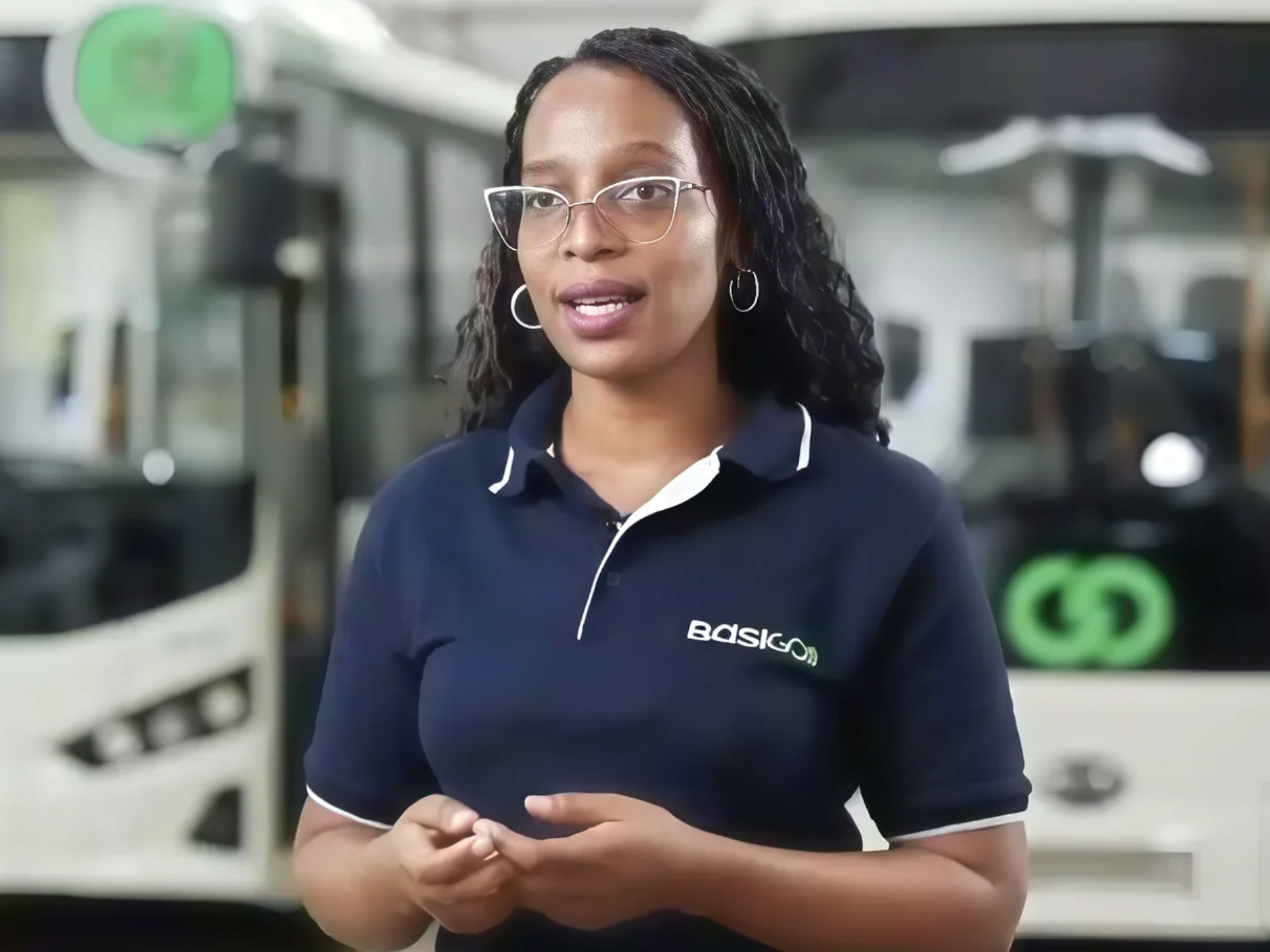
Doreen Orishaba began her career building electric vehicle prototypes at Makerere University in Uganda. Today she is Chief Product Officer of BasiGo, the company electrifying public transport in Kenya and Rwanda, and after more than a decade spent turning the electric bus into a business, she is deciding where cleaner public transport in Africa goes next.
When fuel prices rose sharply during the recent conflict in the Middle East, one Kenyan bus operator did not need to change its fares. OMA Services Limited, a Nairobi transport cooperative, runs a fully electric fleet supplied through BasiGo, so its costs did not depend on the diesel market that sets the budgets of most public transport in the region. For Doreen Orishaba, Chief Product Officer of BasiGo Group, that episode is the clearest evidence that electric public transport in Africa is no longer a theory.
Why Electric Buses Matter to Africa’s Energy Future
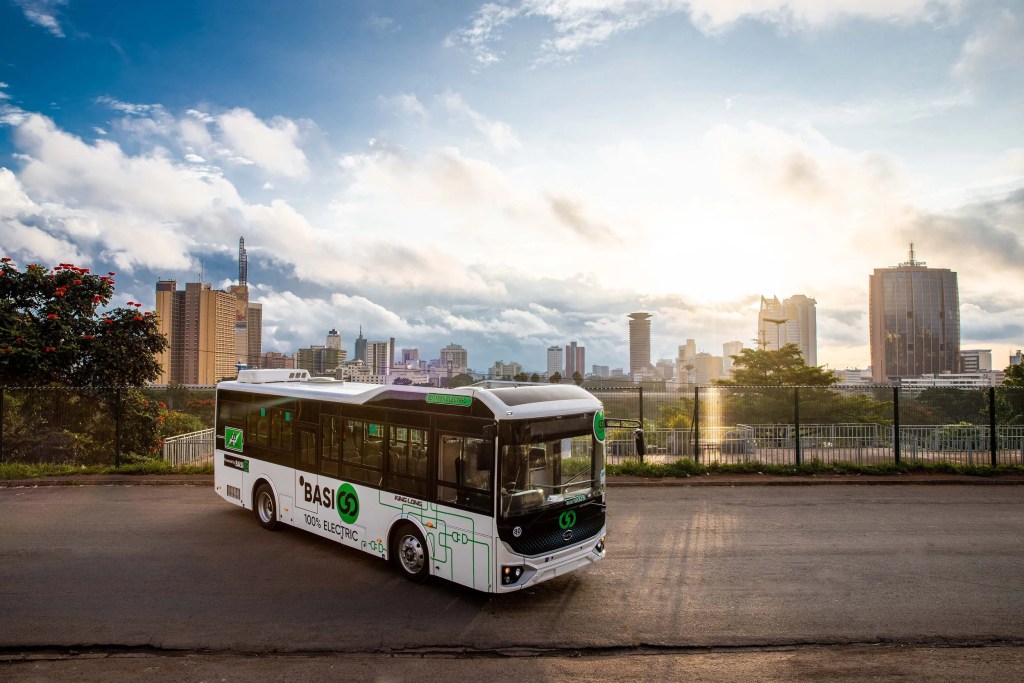
Discussion of Africa’s energy future usually focuses on power generation, grid expansion and the future of oil and gas. Transport gets less attention, even though it is where energy costs reach ordinary citizens most directly: in the fare a commuter pays each morning. BasiGo operates in Kenya and Rwanda on a simple idea. If bus and van fleets move from diesel to electricity, several gains arrive together. Tailpipe emissions fall, operators become less exposed to fuel price shocks, and the energy that moves people comes from the grid rather than from the diesel pump.
The company has the numbers to support that argument. BasiGo has deployed 179 electric vehicles, carried more than 15 million passengers and avoided more than 6,000 tonnes of carbon dioxide emissions since it began operating. Each diesel bus it replaces removes more than 50 tonnes of carbon dioxide a year. Its stated goal is 1,000 vehicles within three years, which would mean growing its fleet more than fivefold.
From Kiira Motors to BasiGo: An Engineer’s Journey
Orishaba has been involved in almost every stage of this story. She first encountered electric mobility as a student at Makerere University around 2011, when Kiira Motors, Uganda’s pioneering electric vehicle venture, set out to build Africa’s first electric vehicle. She joined the effort as a Vehicle Electrics and Electronics Engineer and was one of only two women on the engineering team. She helped design and build Africa’s first solar electric bus prototype and later worked on Uganda’s Electric Bus Pilot Project. At a time when much of the world saw electric vehicles as luxuries, she saw a practical answer to African needs.
Her degree in Electrical Engineering from Makerere was followed by a Master of Science in Engineering Management from Kettering University in the United States and automotive design training with Ford Motor Company. That mix of training matters. Kiira Motors showed her how to build a vehicle. BasiGo would test whether such a vehicle could support a business.
Taking BasiGo’s Electric Buses From Pilot to Market
At BasiGo she led the launch of the company’s first two electric buses in Kenya. As Head of Electric Vehicle Programmes, she then took the product from pilot to its first phase of commercial deployment. Her main lesson from pilots in three countries is that no single template fits every market. The buses BasiGo runs in Kenya differ from those in Rwanda because each market asks something different of the product.
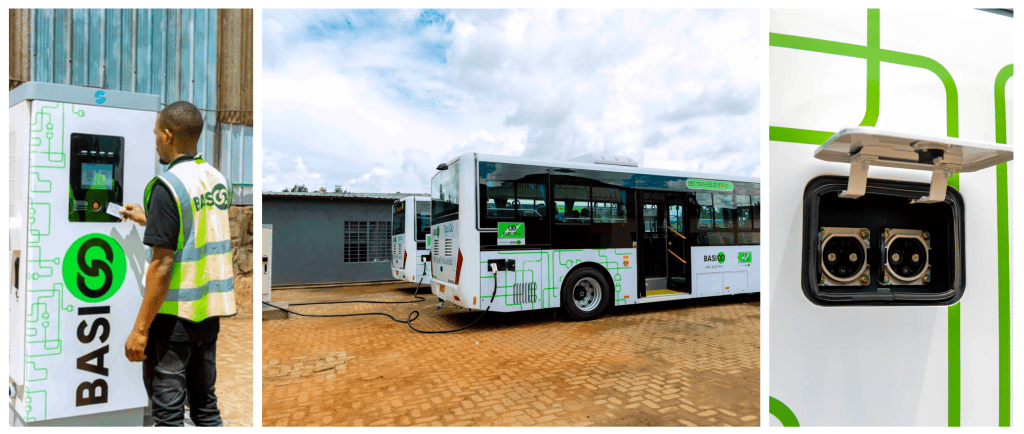
How BasiGo Rwanda Became a Profitable Electric Bus Business
Rwanda became the real test. As Managing Director of BasiGo Rwanda, Orishaba adapted the vehicles for the country’s hills and insisted that the operation run on strict commercial terms, with every investment weighed against costs and returns. The company describes the result as the first profitable electric bus business in Africa south of the Sahara. She credits a supportive policy environment. Rwanda has directed that 30 per cent of new government vehicles be electric, offers tax exemptions to the sector, has an electricity tariff designed for electric mobility and uses standardised, cashless fares that show operators and lenders exactly how much revenue comes in. Banks began supporting the business directly as a result. She adds that the business has shown it can operate without subsidies.
Pay As You Drive: Solving the Finance Problem
Policy alone does not explain BasiGo’s model. The company’s view is that the barriers to electric buses in Africa are as much financial as technical. Under its Pay As You Drive model, operators can use electric buses without paying the full vehicle cost upfront, while BasiGo provides the charging infrastructure and maintenance that keep fleets running. Orishaba says operators who switch are saving 20 to 30 per cent. A partnership with the global battery manufacturer CATL allows BasiGo’s technicians to service and repair CATL battery technology across Africa south of the Sahara. The Kenyan lender NCBA has agreed to finance up to 1,000 BasiGo electric vehicles.
Global Recognition and BasiGo’s Next Market
Outside recognition is growing. BasiGo was named among BloombergNEF’s 2026 Pioneers in April 2026. In August 2026 it joined Unlock Aid’s Future Generations Solutions Index as one of 40 organisations in its latest cohort. This recognition comes as the company decides what to do next.
As Chief Product Officer, Orishaba has three current priorities: continuing to improve the vehicles already on the road, developing new products for sectors beyond public transport, and choosing BasiGo’s next market, depending on the funds available.
In the conversation that follows, she explains what first drew her to electric mobility, what pilots in three countries taught her, what it took to make Rwanda profitable, and why she believes the economics of electric public transport in Africa are now proven.
The Interview: Doreen Orishaba on Electric Mobility in Africa
Q. You have spent more than a decade working in the electric vehicle space in African countries. What first drew you to electric mobility?
I was first exposed to electric mobility at Makerere University in Uganda in 2011 and 2012, when Kiira Motors was trying to build Africa’s first electric vehicle. We went from a very small first electric vehicle to the first hybrid electric vehicle, and then to the first solar electric bus built from scratch in Uganda. The rest of the world saw electric vehicles as luxuries at the time, but I could already see the impact they could have in Africa.
Q. What has kept you in the electric mobility sector over the years?
Two things have kept me here. The first is the impact. The second is that I have been through every stage, from product development at Kiira Motors to commercialising the electric bus at BasiGo. We have 179 buses on the road, and we are proving that the technology works and that the business model works. That is true for the climate, and it is also true commercially. Operators are saving 20 to 30 per cent by going electric.
Q. You have led electric bus pilot projects across Uganda, Kenya and Rwanda. What have these experiences taught you about successfully introducing electric public transport in African markets?
You can have a framework, but one framework cannot fit every market. Solutions have to be tailored. The pilot at Kiira Motors in Uganda was mainly a proof of concept. When I moved to BasiGo, the question became how to commercialise the electric bus. We tested in both Kenya and Rwanda, and the buses we run in each country are different. You have to understand what a specific market needs and build the solution around those needs. A pilot gives us that information before we scale.
Q. At BasiGo, you progressed from Electric Bus Project Manager to Chief Product Officer. Talk to us about this journey.
My journey largely mirrors BasiGo’s. As electric bus product manager, I was responsible for launching our first two electric buses here in Kenya. After that I led the deployment of our commercial vehicles, from pilot to the first phase of commercialisation, and adapted the product to the market. I then went to Rwanda as Managing Director to expand into that market. Now, as Chief Product Officer, part of my job is deciding which market comes next.
Q. As Managing Director of BasiGo Rwanda, you helped establish the first profitable electric bus company in Africa south of the Sahara. What did it take to build a commercially sustainable business?
We took the product development lessons from Uganda and the design for commercialisation from Kenya, and applied them to Rwanda’s specific needs. We had to understand what kind of product would work in the hills. We also knew this had to be run as a business. It was good for the climate, but it still had to appeal to operators and investors. We tracked closely what we put into the business against our costs and our earnings, because that was the only way it could become profitable. Policy helped as well. Banks came in to support us directly because Rwanda has a government directive that 30 per cent of all new government vehicles should be electric. In the end it was all those lessons together, plus the support of our cofounders, Jit and Jonathan.
Q. What lessons from the Rwanda experience can be applied to scaling electric mobility across Africa?
Government support is key. We have shown that we can operate without subsidies, and in Rwanda government policy has supported both the electric vehicle industry and wider adoption. That support includes tax exemptions, an electric mobility tariff for charging infrastructure, and a standardised, cashless fare system. Cashless fares reduce risk because they confirm exactly how much revenue has been collected. The other lesson is that it has to work for the operator. If an operator sees no reason to go from one electric bus to ten, you do not have a business.
Q. After more than a decade in the sector, what excites you most about the future of electric public transport in Africa?
What excites me most is knowing that it is possible. It is no longer a theory. We have proved that it works, and that the economics work for operators and for BasiGo. Think of the recent conflict in the Middle East, when fuel prices shot up. In Kenya, OMA, one of our operators with a fully electric fleet, never had to raise its fares. That is the proof, for the climate and also for reducing energy dependence and keeping costs manageable for operators. The exciting part now is scaling our products and markets, and showing future engineers that there is a place for them in this work.
About BasiGo
BasiGo supplies electric buses to public transport operators in Kenya and Rwanda through its Pay As You Drive model, which spares operators the full upfront vehicle cost while BasiGo provides charging infrastructure and maintenance.
Discover more from Pan-African Voice
Subscribe to get the latest posts sent to your email.