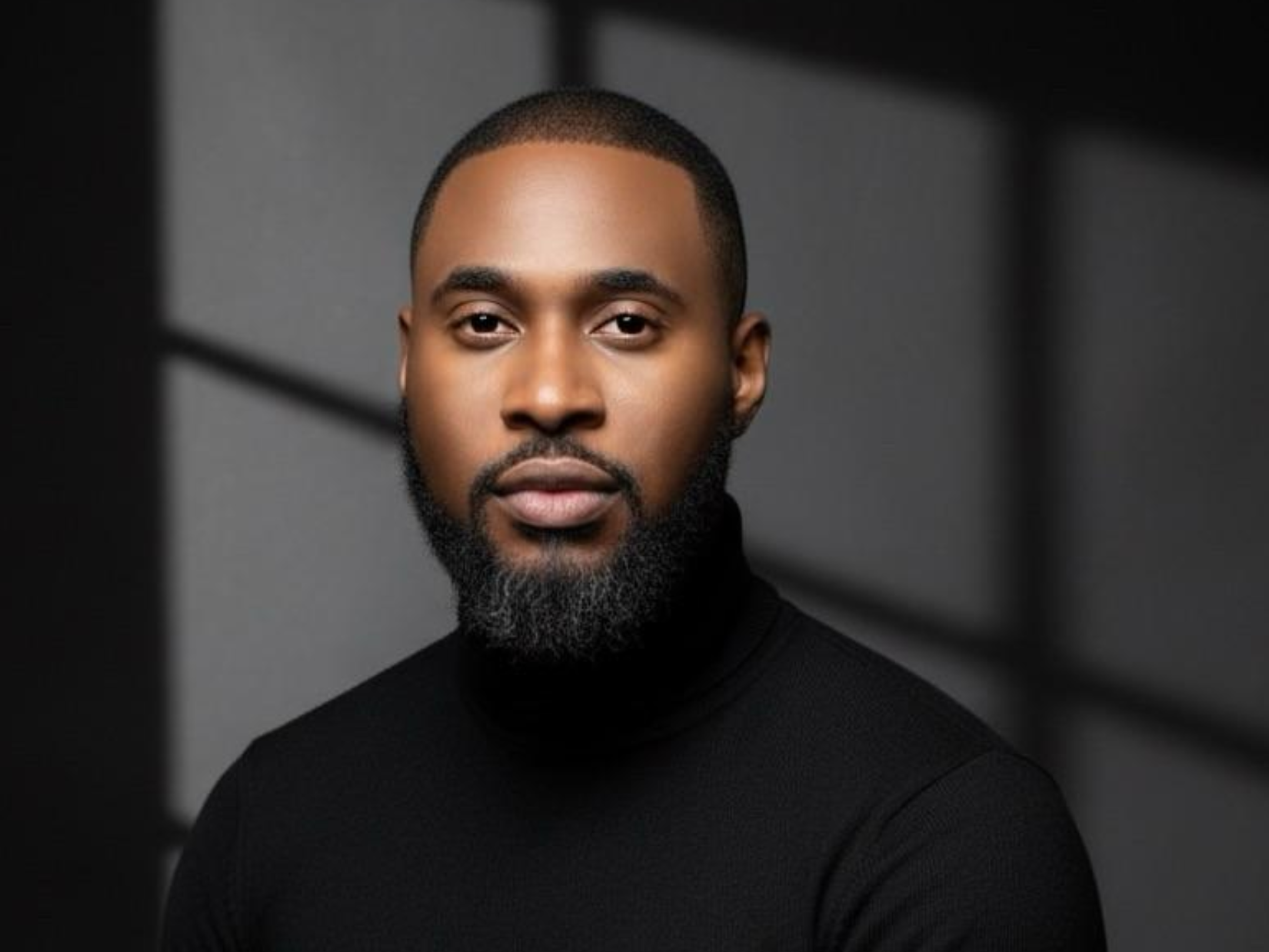
He never set out to act. A reality television win carried Chris Okagbue onto Tinsel and into a lasting Nollywood career. In our exclusive interview, he explains why he is now producing films and writing screenplays to gain a real say in which stories get told.
Chris Okagbue’s path into Nollywood ran against the usual pattern. Where many actors spend years pursuing auditions, he says the opportunities found him first: a major advertising campaign, a television role and a casting call he initially declined. More than two decades later, he is an established actor, a producer and a screenwriter with clear ambitions for African film.
He grew up in a large Igbo family in Onitsha, Anambra State, where his late father was the Obi of Onitsha. Raised with no special treatment despite that status, he set aside the title of prince while still at secondary school. The ambition he carries today is personal: to make the Okagbue name known for work that is unmistakably his own.
His route into entertainment ran through his older sister, already a successful model when the family moved to Lagos after his father’s death. Accompanying her to a photo shoot led to his first audition and his first job, a Milo campaign that ran across billboards and newspapers. Being paid at seventeen for work he enjoyed changed his thinking. Steered like so many Nigerian children towards medicine, he spent five years trying to secure a university place through the sciences before switching to the arts, where within six months he was tutoring other students. He went on to read sociology at the University of Lagos.
Okagbue dates his first true breakthrough in 2011, when he won the eighth season of Gulder Ultimate Search, the jungle survival reality show. A role on the soap opera Tinsel came next, followed by television series and feature films.
His story speaks to a broader shift in African entertainment, where visibility does not guarantee security or creative control. Actors can go months without a call, and casting can favour familiar names over the best fit. Okagbue has responded by moving behind the camera. He has produced two films in partnership with an experienced producer, is developing screenplays of his own, intends to direct and hopes to make a high quality Nigerian action film. His stated goal is to take his work onto major streaming platforms and into cinemas beyond Africa, one stage at a time.
For young creatives weighing a career on the continent, he offers something more valuable than glamour: a candid account of the work, the patience and the faith that sustain it. As he puts it, a story that takes time is still a story, and often the most interesting one. In an exclusive interview with Pan-African Voice Editor in Chief Collins Nyatanga, Okagbue reflects on his upbringing, his breakthrough, the realities of Nollywood and the advice he would give his younger self.
Take us back to the beginning. What was childhood like for you in Nigeria?
It was a lot of fun. I grew up in a very large household with five siblings and a crowd of cousins, because my mother was one of eight children. We lived in a huge compound and there was never a dull moment. At my primary school there was an Okagbue or relative in almost every class, so the walk to school each morning felt like soldiers being deployed. I am Igbo, from Onitsha in Anambra State, and my late father was the Obi of Onitsha, so I was born a prince. But we were raised like regular children. There was no special treatment. If you failed a subject, you were flogged like everybody else. I dropped the title of prince early in senior secondary school because I did not like the attention it drew. If people do not ask, I do not tell.
Did you ever feel pressure to carry the royal name in a particular direction?
Not in the way people imagine. While my father was alive, being the son of such a well known king meant I had to carry myself a certain way, because I represented the family. Since he passed, the pressure has changed. Many people already know the Okagbue name, but I want to build something of my own. I would like people to say that he has done this and that, and by the way, did you know whose son he is? Not the other way round. That is the only pressure I have felt, and I still feel it.
Was there a moment when you first felt the pull of performance?
Yes. I was an extremely shy child. When I was about ten or eleven, we attended Sunday mass at a convent near my mother’s hometown, and they held events for the children. My younger sister was supposed to read to a big gathering of children and parents, but she got stage fright on the day, so they asked me to do it. I remember holding a microphone almost the size of my head, and when I finished, people stood and clapped. That was the first time I thought, this is not so bad. Years later, after my father passed and we moved to Lagos, I followed my older sister, who was already a successful model, to a photo shoot. Her agent suggested I take a few pictures. Some time afterwards he called me to an audition with a huge crowd of hopefuls, and I got the job. It was a Milo campaign on billboards, posters and newspapers. It was my first audition and my first job.
At a time when young Africans were pushed towards medicine, law and engineering, what did that first pay cheque change for you?
It changed something in my head. My mother, like most African mothers, wanted me to be a doctor, and I convinced myself I wanted it too. But I failed chemistry and physics woefully. Being paid at seventeen to do something I would have done for free, in shoots that lasted a few hours, showed me I could succeed outside the path my mother had chosen. I still tried to get into university to study medicine, and every year my score fell further below the required mark. In the end it took me five years. I switched from the sciences to the arts, and within six months I was tutoring other students. I wanted to study mass communication, but I lacked one required subject, so rather than wait another year I chose sociology at the University of Lagos. I was already in the entertainment industry, which was the goal anyway.
You never wanted to act. How did it begin?
It happened by accident. Some model friends who were interested in acting went to an audition for a television series near my house, and I went along to keep them company. They were nervous, I teased them, and in the end I auditioned just for the sake of it. Of the four of us, I was the only one called back. I told the director I was not interested because I was preparing for my exams. A year later he called again and asked me simply to come and read something. I did, and I got a role on a series called The Station. My big scene was a monologue of a page and a half, and I did it in one take. The same director then cast me in The Maze, a story about teenagers and peer pressure, and that was the first time I thought I might give acting a proper try.
Many people would call those first roles your breakthrough. What was yours?
For me, it came in 2011. After those two series I did not act at all and went back to modelling. In 2010 my best friend convinced me to try out for Gulder Ultimate Search, the survival show where contestants live in the jungle, complete tasks and face eviction until a winner emerges. It was the biggest show on television at the time, and families watched it together. We were not picked that year. I tried again in 2011 and made season eight, which for the first time took thirty contestants in three batches. I went on the show to push my career, especially my music, and I did not believe I would win. But I did. Before I had even left Edo State, where we filmed, I was called to read for Tinsel. The director in that room had worked on my very first series, and for the first time in my acting life I felt the need to prove a point. I got the role, and from there the work snowballed into more series and my first feature films.
Fame arrived quickly after that. What stayed the same?
It is hard to see change in yourself, but I do not think much has changed, for a few reasons. I was raised in a royal family without any sense of entitlement. I also had a blueprint in my sister, who was famous before me. I watched how she handled the good and the bad, so when my turn came, the transition felt natural. Most importantly, I have a very small circle of people I consider blood, even though we are not related, and they are well grounded. They keep me grounded. I could not be different even if I wanted to.
Strip away the red carpets. What would fans be surprised to learn about life as a Nollywood actor?
That we go through regular struggles like everybody else. I love what I do, but I do not always like it. We are also not as rich as people think. Show business is about showing more than you have, and I am not interested in that part of it. Some colleagues have told me I should not post the random things I share on social media, but I cannot be anyone else. Then there are the hours. I can have a call time of seven in the morning and still be on set at two the following morning, with another early call waiting, for four or five days in a row. That takes a physical toll.
Have you had seasons when your face was everywhere but your bank account told a different story?
If I said no, it would be the biggest lie on earth, and everyone in my industry has experienced it, even if they will not admit it. There are months when I am on set every other week, and stretches of six, seven or eight months when the phone does not ring once. My friends with regular jobs have something I do not, which is job security. In my line of work you are only as good as your last project, and a film can underperform commercially for reasons that have nothing to do with you. That is why you have to use your head and build other legitimate sources of income while you pursue the dream. When you have several talents, each one can become a stream of income.
What are the politics of the industry that fans never see?
I would not call them unspoken, because I have been in rooms where these conversations happen. I have lost roles I knew I was better suited for, sometimes because of personal relationships between other people. People tell me that with my talent I should be miles ahead, and on one level they are right. But I believe that what is mine is mine, and I do not fight for things. Someone once called me looking for another actor’s number. I checked with him first and passed it on, and a few days later they called back to offer the role to me instead. I believe that when you take what is not yours, you struggle in that production. I do think the industry should focus more on talent than on names. I understand that investors want their money back and that names sell, but I have seen big names fail and unknown faces succeed. At the end of the day, we are meant to be telling stories that move people.
You have stepped behind the camera as a producer. Why, and what does it take to turn an idea into a film?
I am still learning. Around 2017 I was credited as an associate producer on a film where I played the lead, but that was mostly a title. My real start has been a partnership with an established producer, because I wanted to learn from him, and we have made two films together. The driving force is a hunger to tell my kind of stories. As an actor you are employed on a project and you play the role you are given. As a producer you call the shots. The first question is always what story you want to tell. Then you decide on your audience and your platform, and those choices set your budget, which is the main problem in Nollywood. A film for Netflix, Prime Video or the cinema needs a certain standard of camera, cast, locations, sets and costumes, and all of that costs money. A short film for YouTube costs far less. I believe in starting small. I still want my films in cinemas beyond Nigeria and beyond Africa, but I want to crawl, walk and run before I fly. I also write screenplays. The notes on my phone are full of plot lines, and some of those stories I would never hand to anyone else. Eventually, I want to direct.
How has your experience as an actor shaped the producer you want to be?
I have felt creatively restricted on some sets, as I think every actor has, because every director has a style. The best films merge the vision of the director with that of the actor, and having more control from beginning to end is part of what draws me to producing. I also want to explore genres we have not fully exploited. Nigeria has always done drama well, and we have made some good action films in recent years, but I want to make a really good action film. I am athletic and I know what I can do physically. A friend of mine who is a visual effects artist and I once shot a short fight sequence with no budget, choreographed on the spot, and put it on YouTube. People loved it. Imagine what we could do with proper resources.
Rejection is part of every creative career. How have you dealt with it?
Early on I barely experienced it, because I was not chasing auditions. It came later, once I was already working. I give my absolute best at every audition or reading, and if I do not get the job, it was not meant to be. Some of the roles I lost really hurt, because you picture yourself doing them. But to anyone hearing no after no, keep going. You only need one good yes to set up your career, and you will never get it if you stop trying.
If you could speak to yourself at nineteen, dreaming of Nollywood, what would you say?
I would tell him to pursue music, which is my first love. Just do it. Do it scared, but do it anyway. I held myself back for years out of fear of failing, fear of not being liked, fear of rejection. With acting I was not afraid, because I did not mind whether it worked out. With music it had to work, so I waited until I felt I had everything in place. Now I realise I never needed all the answers before starting. So to anyone trying to break into the industry in Nigeria, whether in music or film, go for it. There will be obstacles and plenty of rejection, but you need just one solid yes. Your story may not be an overnight success, but it is a story regardless, and the long ones make the most interesting stories. Put God first. Sometimes we are drawn to what we think we want, as I was with the sciences in secondary school, until we are redirected to where we are meant to excel.
Has your definition of success changed since you started?
No, it has always been the same, and I think that is why I am content. Making money is great, and making money doing what you love is even greater, but that is a bonus, not the end goal. Success for me is doing what I love, earning from it, and being able to afford what I want and to travel where I want. I am not a billionaire, and I do not think I want to be. There are things I still aspire to, but if I never get them, I will not feel I have failed. What matters most is being happy, healthy and able to do the work I love.
Discover more from Pan-African Voice
Subscribe to get the latest posts sent to your email.