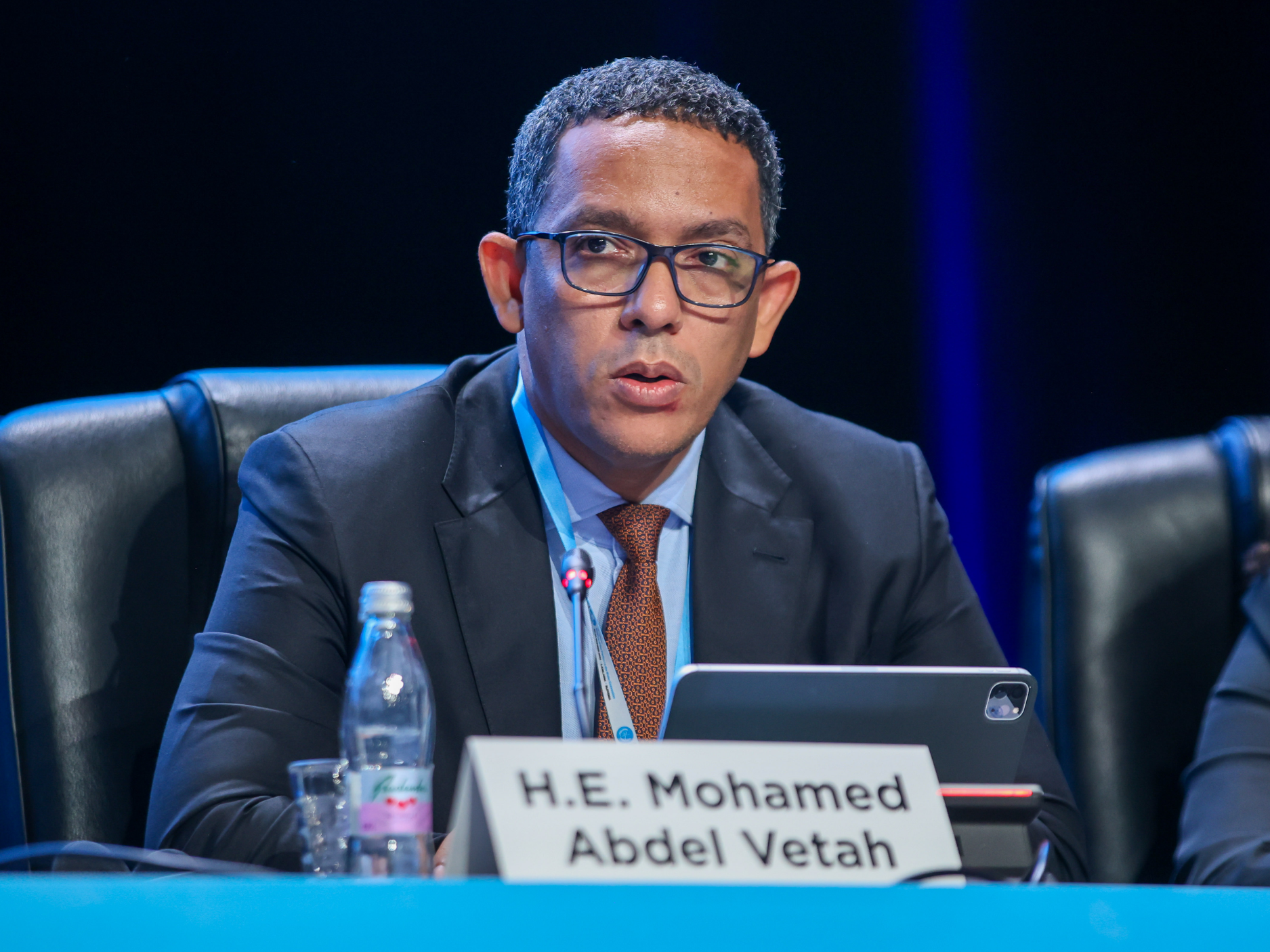
Mohamed Ould Abdel Vetah held Mauritania’s energy portfolio when the country signed the deal that made it a gas exporter. Six years on he is back, and his appearance at MSGBC Oil, Gas & Power 2026 in Dakar will give investors direct access to the official now opening the country’s power generation to private capital.
When Mohamed Ould Abdel Vetah last ran Mauritania’s energy ministry, the country’s offshore gas was still a commercial plan. He returns to find it flowing. Appointed Minister of Energy and Petroleum on 10 October in a newly formed government of 29 members, he takes charge of a sector that has moved from development to delivery, and of a policy shift that places private investors at the centre of how the country will generate its electricity.
He has confirmed that he will take part in MSGBC Oil, Gas & Power 2026, which runs from 1 to 3 December at the Centre International de Conférences Abdou Diouf in Dakar. For the financiers, developers and utilities expected in the Senegalese capital, the conference offers an early chance to hear from the official who now sets the direction of Mauritania’s gas and power agenda.
A career built in gas
Ould Abdel Vetah’s grounding in the industry came well before he entered cabinet. He served as General Manager of SOMAGAZ, the state gas company, and worked as a consultant to TotalEnergies E&P Mauritania, giving him a view of the sector from both the state side and the operator side.
His first spell as minister, when the portfolio covered Petroleum, Energy and Mines from 2016 to 2020, coincided with a defining moment for Mauritania’s gas ambitions. In 2020, Mauritania and Senegal signed the gas sales agreement for the Greater Tortue Ahmeyim (GTA) project with bp and Kosmos Energy, a commercial milestone for a field that straddles the maritime border between the two countries.
He then spent close to four years as High Commissioner of the Organisation for the Development of the Senegal River, the regional body through which neighbouring states jointly manage the river’s resources. That experience of cooperation over shared assets maps closely onto the cross border nature of GTA, whose long term success depends on alignment between Nouakchott and Dakar.
From gas exporter to gas powered economy
Mauritania became an exporter of liquefied natural gas in early 2025, when GTA shipped its first cargo, and the conference organisers report that the project is now running at full capacity. The next phase is about putting gas to work at home.
Somelec, the national utility, and SNIM, the state mining company, have signed power purchase agreements with Saudi Arabia’s TAQA and Egypt’s GoGas Holding. The agreements sit within a gas to power programme linked to the Banda field and targeted for 2028. For SNIM, whose iron ore operations are central to the national economy, dependable gas fired electricity bears directly on production costs.
The presence of a Saudi energy company in Mauritania’s domestic power supply reflects the growing role of Gulf capital in West African infrastructure. For investors in the Middle East looking at Africa’s Atlantic coast, Mauritania now offers an operating LNG export project, contracted offtake with state entities, and a government that has written private participation into its power policy.
A fully private model for new power
The clearest policy signal for investors is Mauritania’s commitment to a generation model in which independent power producers develop every new plant. Two gas fired plants now under development should bring a combined 550 MW onto the grid.
Renewable capacity is growing in parallel. Somelec has awarded a 15 year concession for a 220 MW solar and wind plant backed by 370 MWh of battery storage, which is due to start commercial operation in the last quarter of 2026. Taken together with the gas programme, it points to a power system built to draw on both the country’s hydrocarbons and its wind and solar resources.
For African energy developers and the development finance institutions that back them, a fully private generation model changes the terms of engagement. It moves the state’s role towards planning, procurement and offtake, and places construction and operating risk with the private sector. How the new minister structures tenders, allocates risk and secures payment will determine how quickly that model attracts capital.
Regional diplomacy as an early priority
Ould Abdel Vetah has moved quickly to show that the relationship with Senegal remains central. On 16 October, less than a week after his appointment, he was received in Dakar by President Bassirou Diomaye Faye and reaffirmed his commitment to cooperation between the two countries. With GTA a shared asset, the visit carried weight beyond protocol.
At MSGBC 2026, which is organised by Energy Capital & Power under the High Patronage of President Faye, he is scheduled to speak in the Ministerial Dialogue on executing the MSGBC region’s energy strategy and in the Mauritania National Spotlight session.
What to watch
The questions investors bring to Dakar will be practical. They will want clarity on the procurement timetable for the gas fired plants, the commercial terms under which independent producers will sell to Somelec, the route to the 2028 Banda gas to power target, and the incentives the government intends to offer to draw new operators into Mauritanian exploration acreage.
Ould Abdel Vetah’s return gives Mauritania continuity at a moment when it matters. He knows the gas sector from the inside, he held the portfolio when the GTA gas sales agreement was signed, and he spent his years outside cabinet working on the kind of regional cooperation the project relies on. Whether that experience translates into bankable power projects and a new wave of exploration will become clearer once he sets out his programme in Dakar.
Discover more from Pan-African Voice
Subscribe to get the latest posts sent to your email.